Roof Maxx · asphalt shingles
Roof rejuvenation
Roof Maxx is a soy methyl ester based water emulsion. It is spray applied and absorbs into the shingle in 30 minutes to one hour, depending on ambient temperature. Asphalt shingles only. Not tile.
As a shingle ages, oil dries, the asphalt becomes brittle, expand-and-contract fails, and the shingle breaks. Treatment restores flexibility.
Each Roof Maxx treatment adds 5 years of warranted service life. Up to 3 treatments for a total of 15 years.
That figure is the Roof Maxx product warranty on the treatment, and it is the only place on this site it belongs. Both that warranty and the warranty we carry on a Roof Coat installation are transferable. Neither is a statement about what an insurance carrier will accept.
The fifteen is a ceiling, not a schedule. We inspect before every treatment, and a roof that has moved past rejuvenation does not get a second pass just because it took a first one well.
Cost is roughly 15 to 25 percent of replacement when the roof qualifies.

What a treatment day looks like
Two people on most roofs, hoses run off the truck, and a pass over every slope. Most roofs are done in a day, and you keep using the house while we are up there.
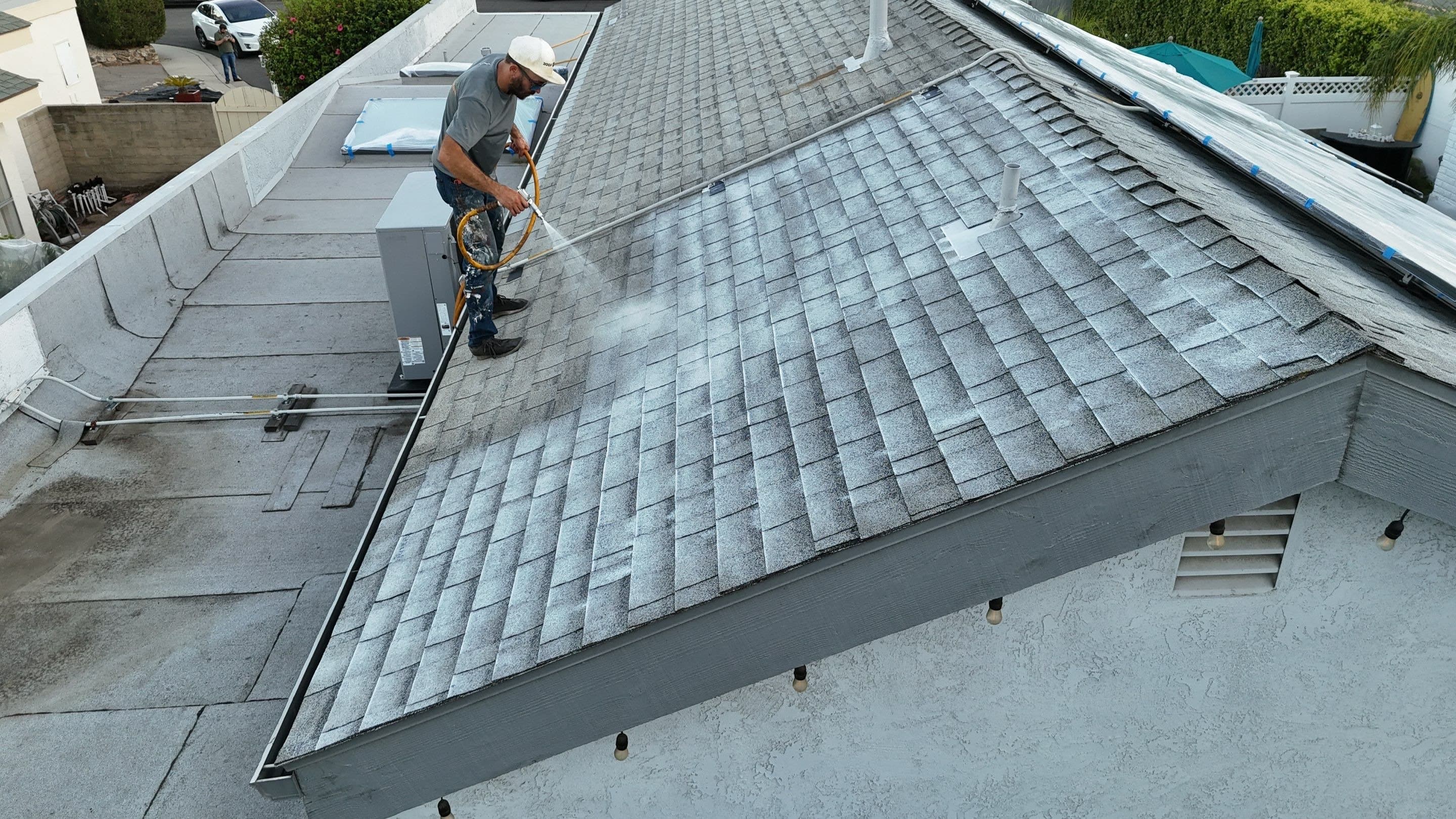
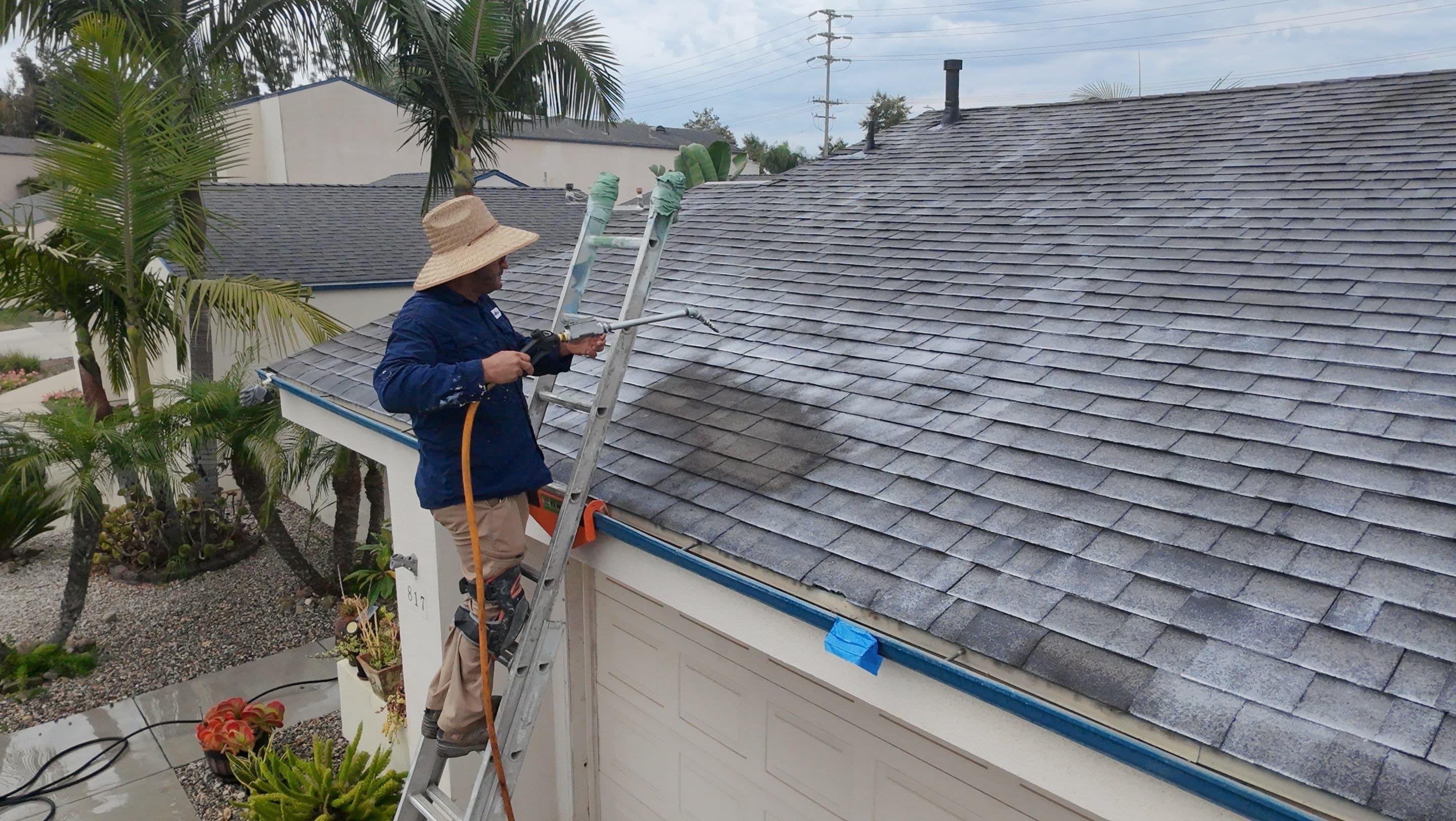
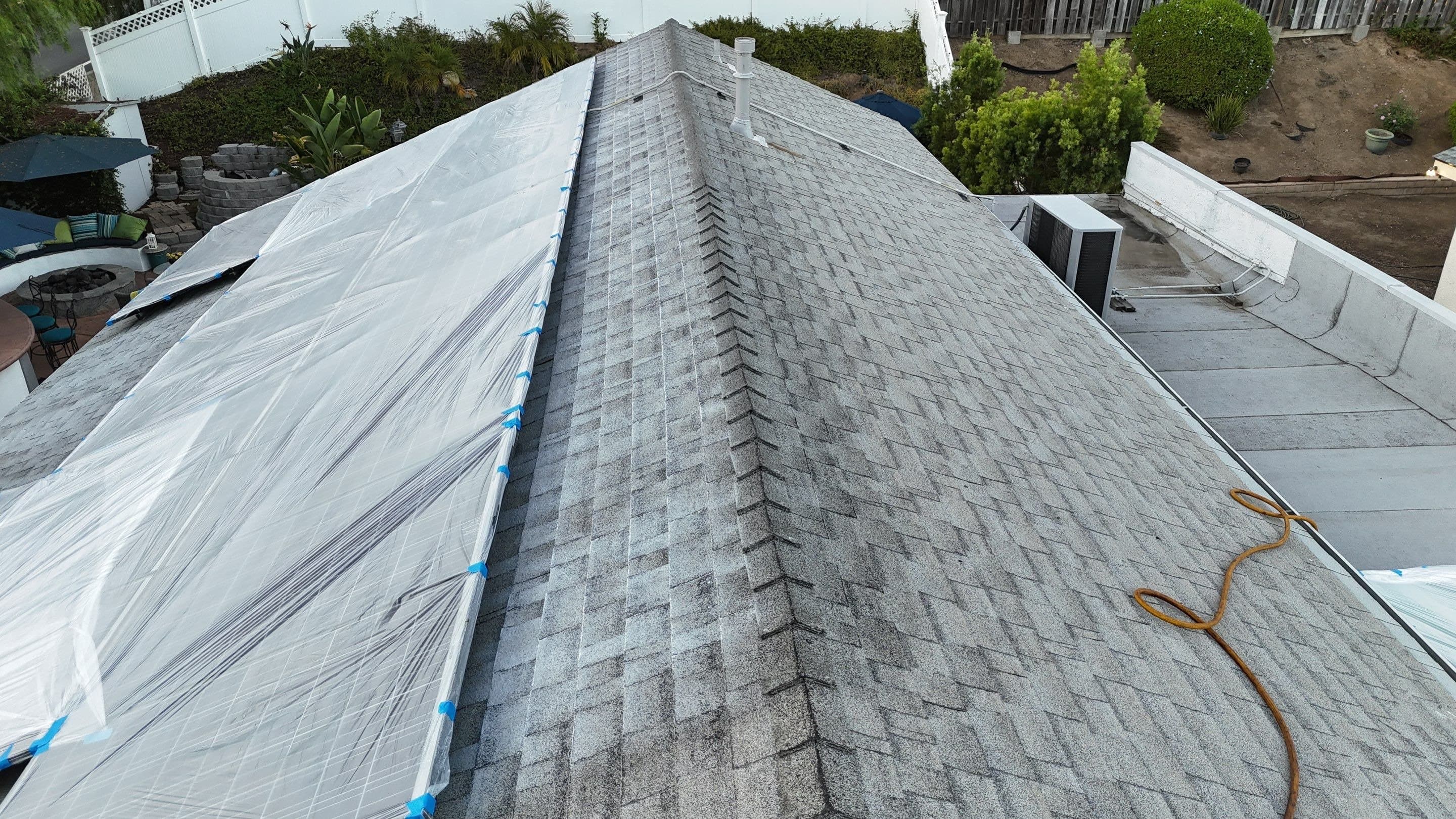
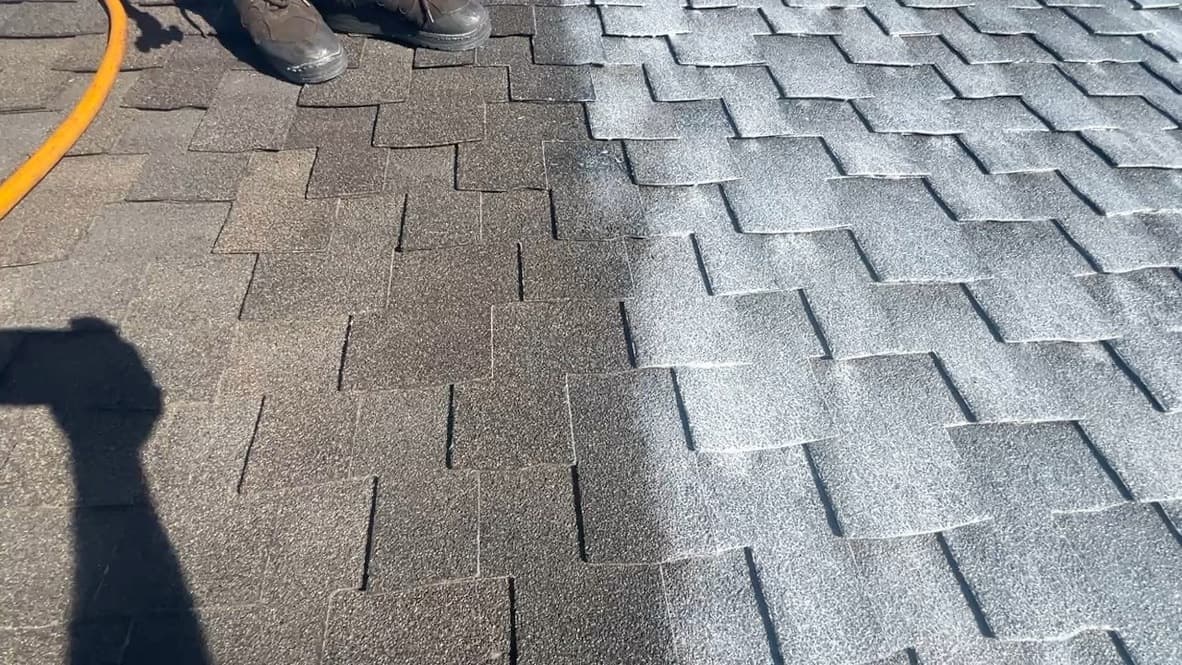
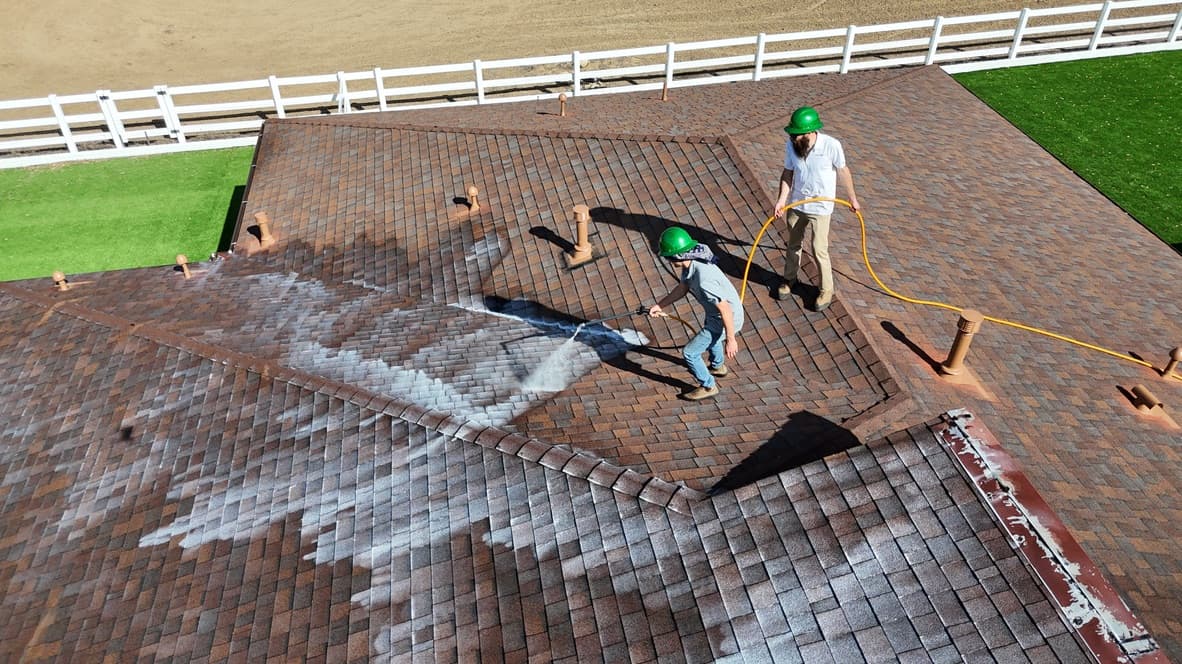
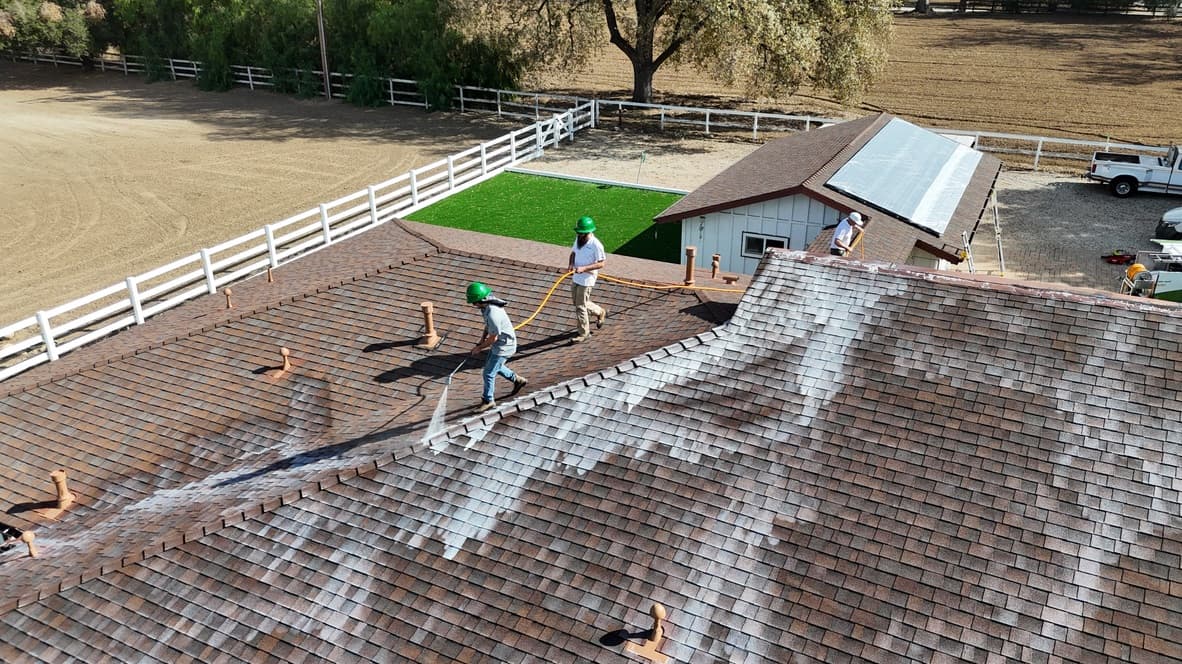
A pass leaves a line you can see with your boots next to it and again from the air. Roof Maxx comes out of the wand milky white, so the field that has just been sprayed is the pale one and the darker shingle next to it is the part that has not been sprayed yet.
That reverses while you watch. Over the next ten or twenty minutes the emulsion starts going into the asphalt, the white fades out of it, and the same shingle reads dark and wet instead. An hour or two after that it has soaked in and the roof looks like a roof again — which is the point, and also why the difference is worth photographing on the day. Both frames below are that first minute, not the last. Up close the edge steps along the courses; from above it is the shape of the whole job.
The roof to treat is the one still doing its job
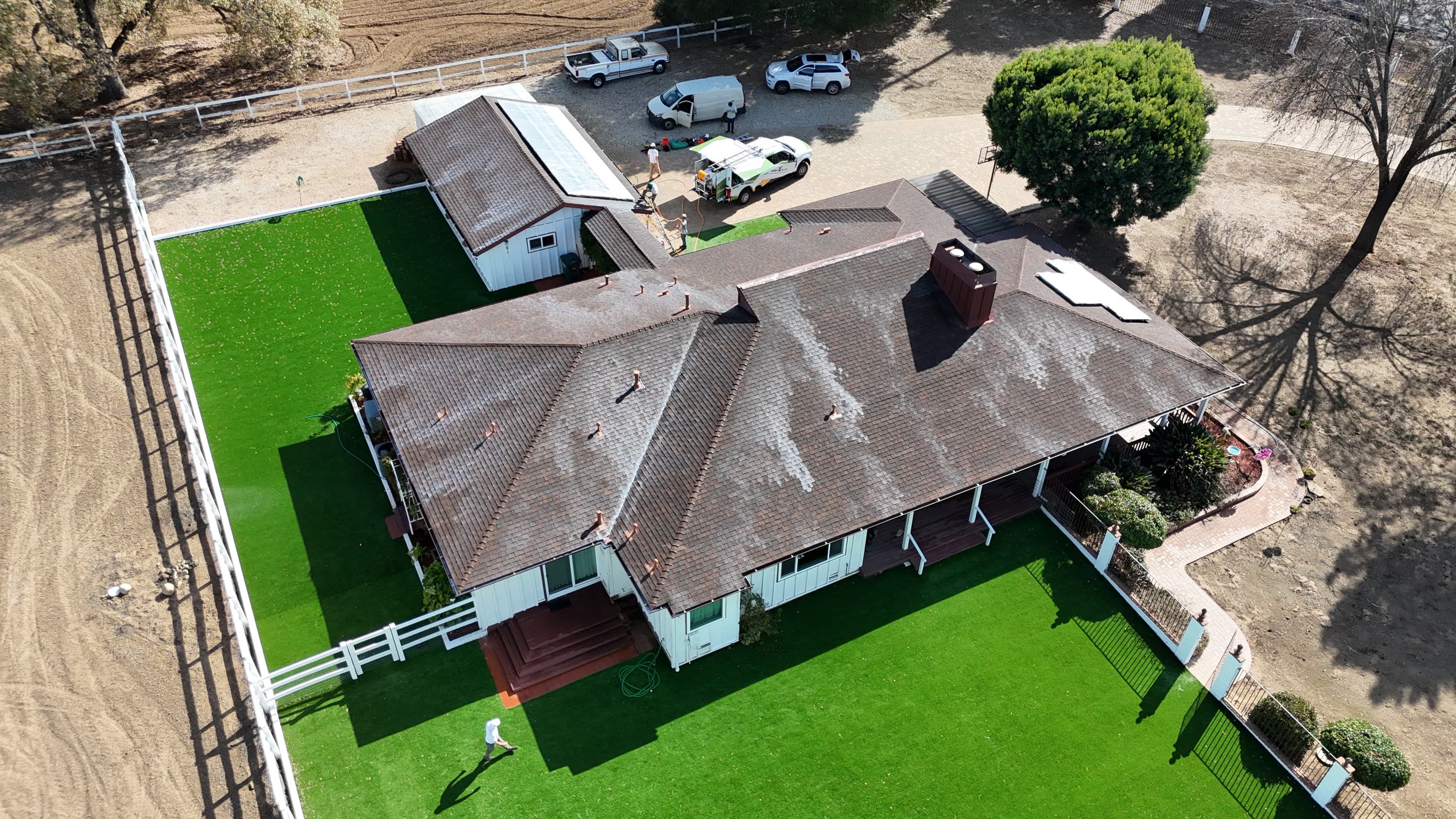
The estate below is in Ojai: a little over 5,000 square feet of composition shingle, fifteen years old, and not leaking. That is the candidate rejuvenation was built for. The mat and the granules are still there. What has dried out is the oil, and the oil is the part we can put back.
Waiting for a stain on a ceiling changes the conversation. Once the mat is showing or the granules are gone, the honest answer is a coating or a replacement, and both cost several times what a treatment does.
It took three of us. Below is that roof twice: the whole property with the passes still white on it, and the leading edge of one moving downslope.
Past the point where oil helps
The rule we work to is about thirty percent granule loss. Past that a roof does not get a treatment from us, and the reason is not the granules. It is what the missing granules have already let happen underneath them.
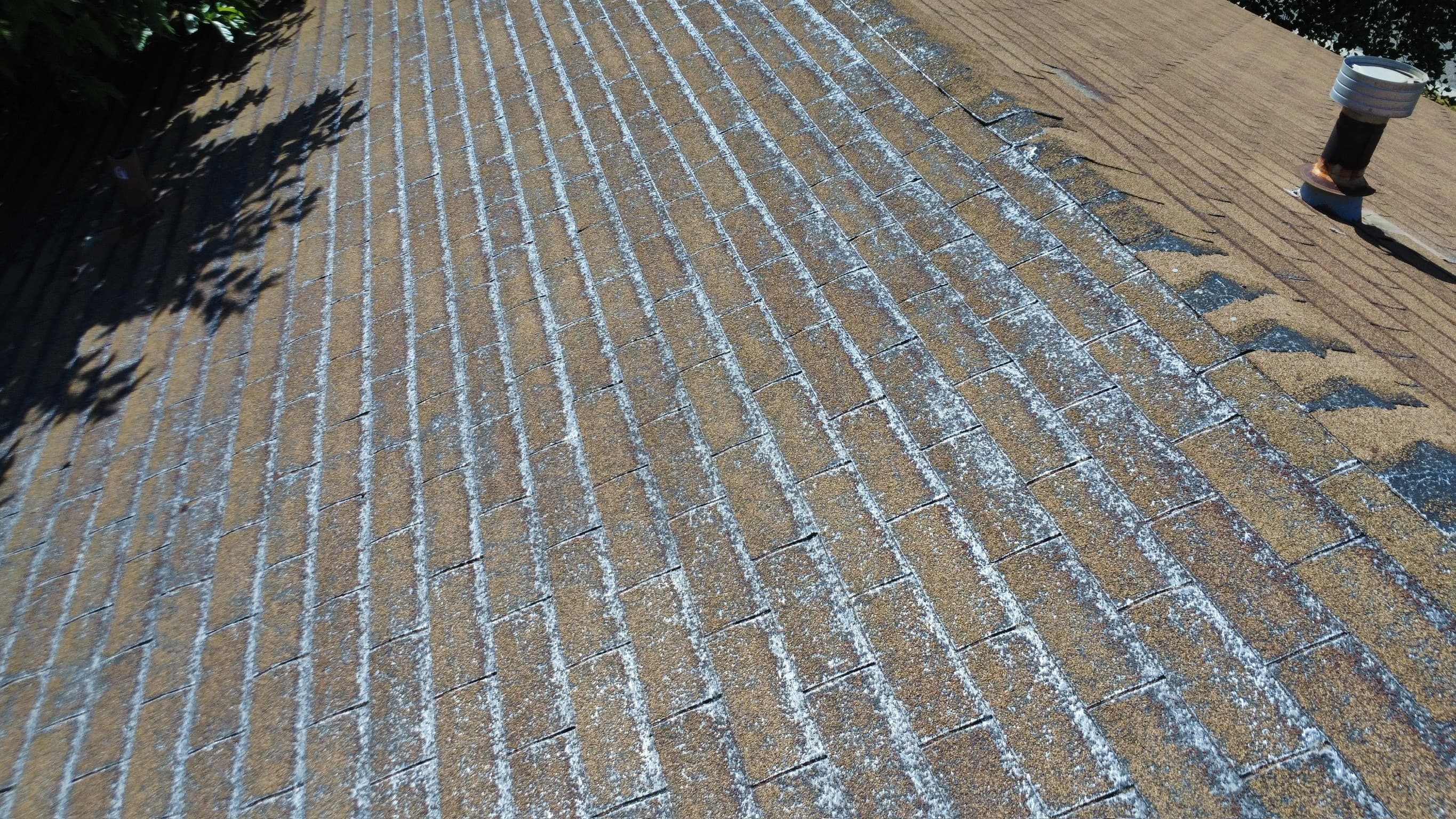
Granules are the shingle's sunscreen. Their job is to keep UV off the asphalt below them, and for most of a roof's life they do it. Once enough of them are gone, that asphalt starts taking the sun directly. It dries, it goes to powder, and it leaves down the gutter over the following winters.
What is left is the fiberglass mat, the web the shingle was built around. That is the pale material running down this slope. Mat is reinforcement, not waterproofing, and there is no oil left anywhere in it to soften — which is the entire mechanism a treatment depends on.
It arrives in stripes because that is how water moves. Every keyway funnels the runoff from the course above onto one narrow band of the shingle below it, so those bands wear out well ahead of the tab faces on either side. From overhead you can see it is not one bad slope.
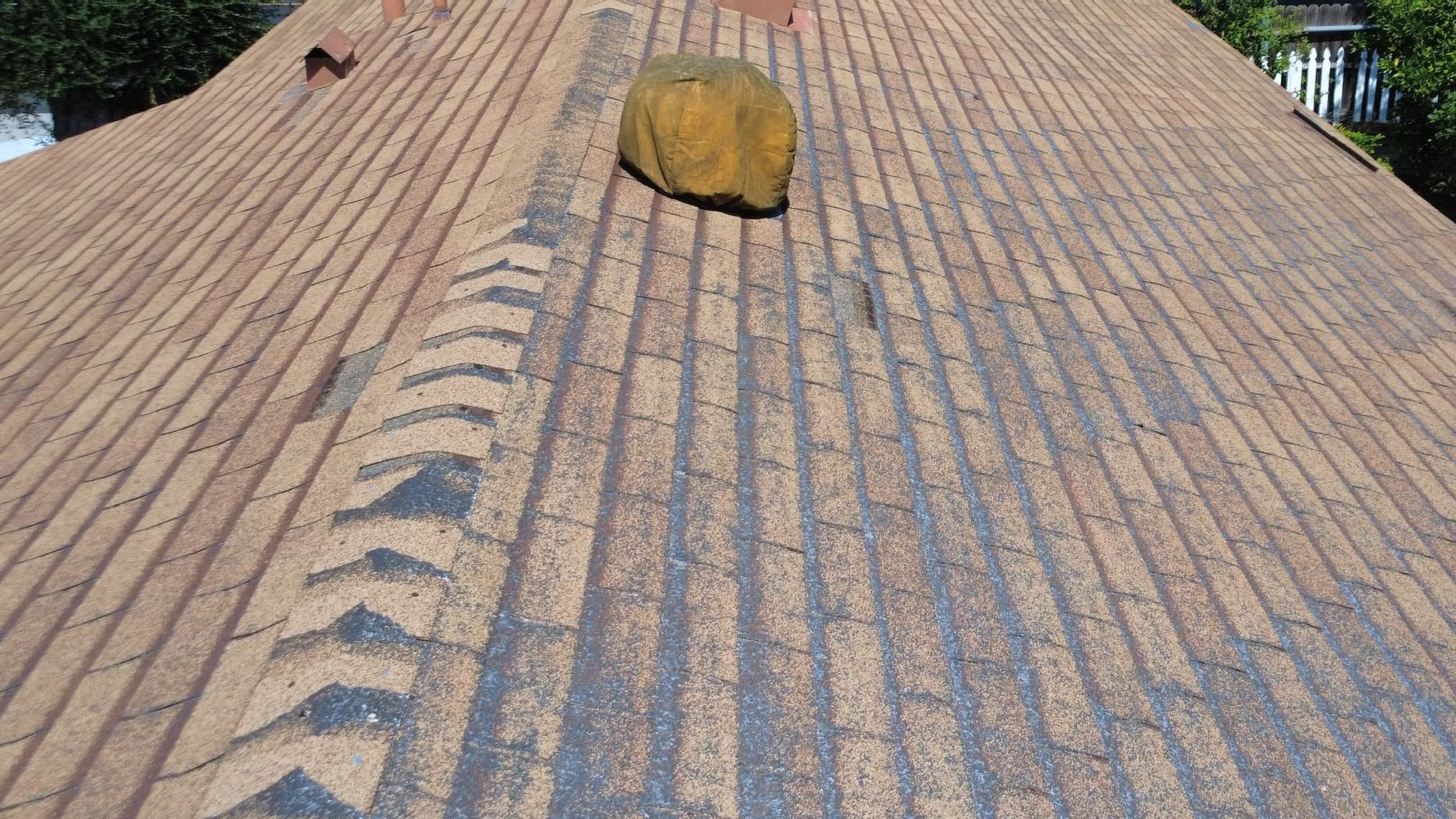
Both frames are the same Simi Valley house, seconds apart. It did not qualify. A roof this far along is a Roof Coat or a replacement, and hearing that at the inspection costs a good deal less than hearing it after you have paid for a treatment with nothing left to treat.
Somebody has already been up here
A single dab of mastic around a pipe collar is normal maintenance and says nothing bad about a roof. Six of them spread across one slope says something else, and it is worth being able to read before an estimate lands in front of you.
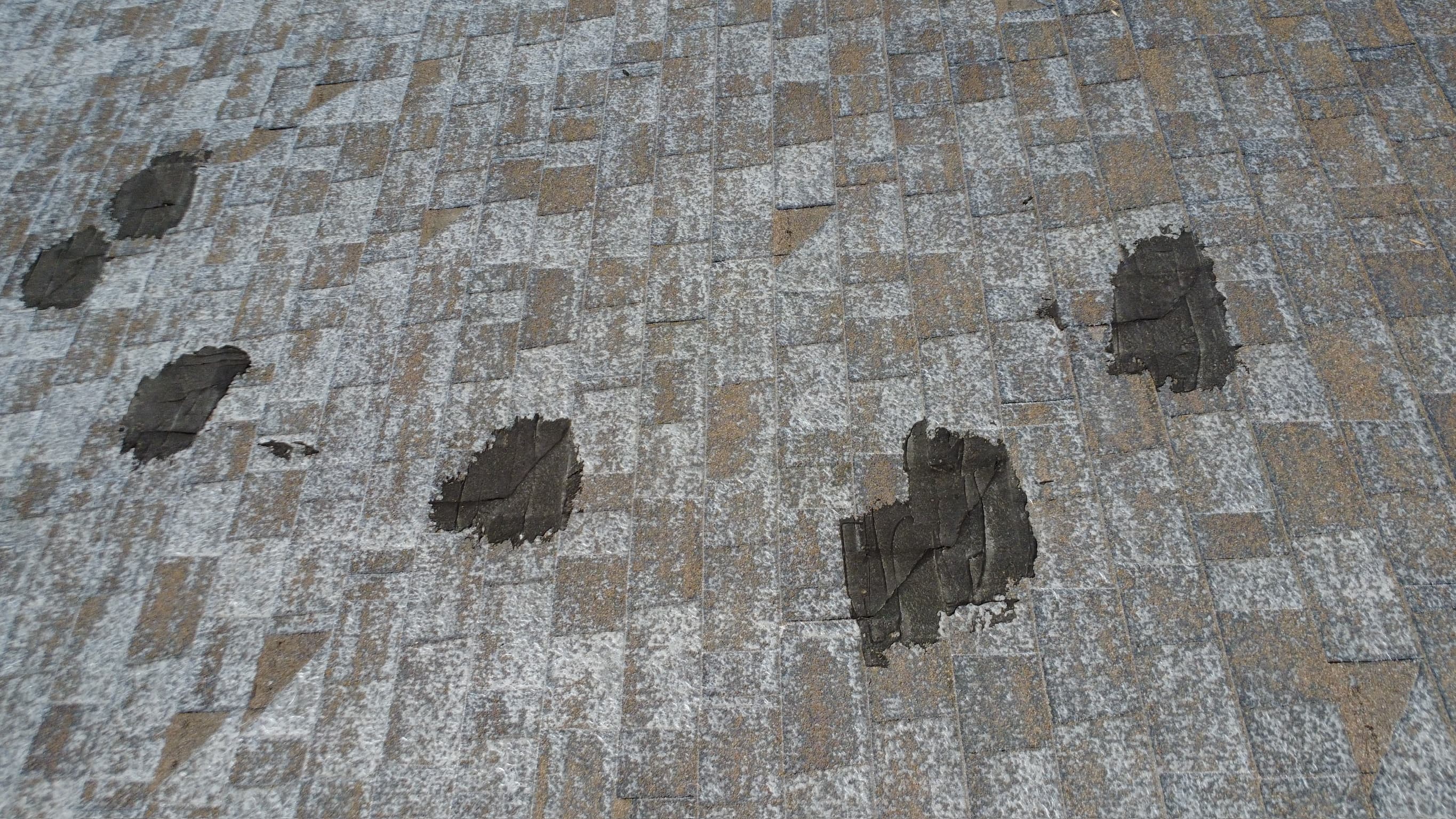
Start with where they are not. There is no pipe, no vent, no valley and no flashing anywhere in that frame. Every patch is out in the open field, on shingle that was supposed to be shedding water by itself, so each one marks a leak that started somewhere nothing was penetrating the roof.
Then look at how they were made. Each is troweled straight across several courses at once, which glues shut the laps the roof relies on to move. Asphalt cement cures harder than the shingle under it, so when the deck warms and the courses shift, the patch is the part that gives. On the largest one here the split runs along the course lap underneath it and one side has already lifted.
We seal things too, and it is in every tune-up: open fastener holes, a tired flashing, a pipe boot gone hard. The difference is what sits underneath. Sealant belongs on a detail the shingle was never asked to waterproof on its own. Troweled across open field it is not a repair, it is another year — and the field around these shows what the year was bought against, mottled pale on every tab where the granules have worn off.
So this slope is off the treatment list, and the patches are the part you can use. They are the first thing visible from a ladder that says the leaks have stopped being one-offs, which is worth knowing while there is still a choice of paths left to make.
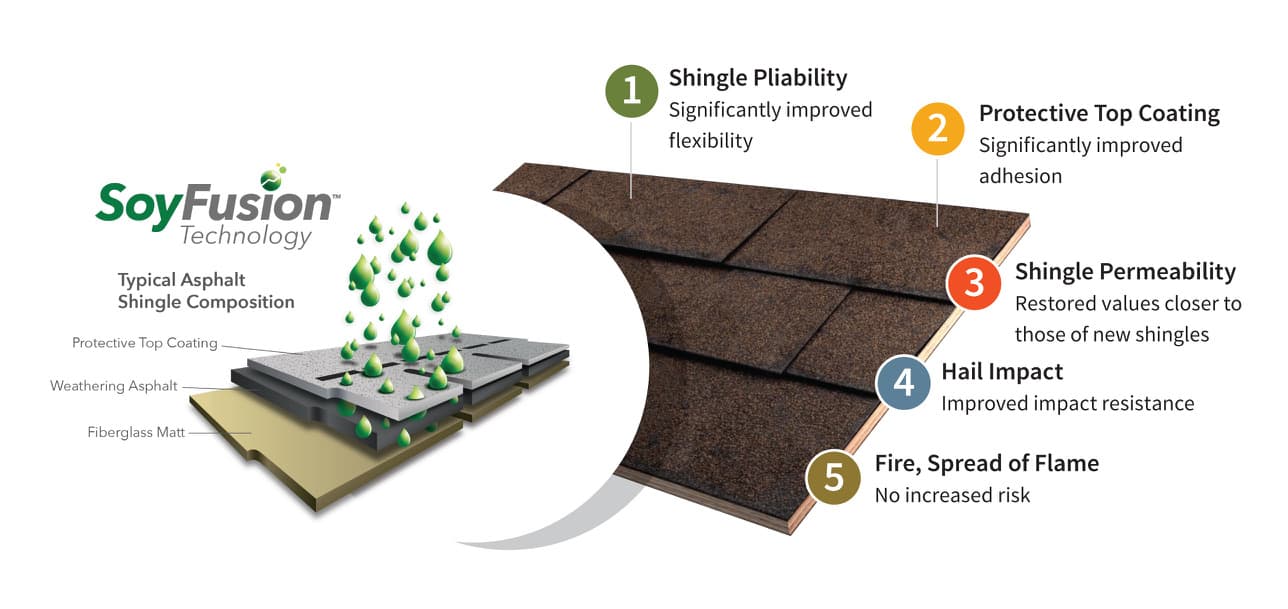
What Roof Maxx says it does
This is the manufacturer's material, not ours — their cutaway and their videos. Read it as the claim. The section after it is the part that was measured by somebody who does not sell the product.
What the 2018 OSU paper measured
Pliability
ASTM D3462 pliability: treated shingles passed, including weather-side down in both machine and cross-machine directions. Untreated shingles failed weather-side down.
Granule adhesion
ASTM D3462 and ASTM D4977 granule adhesion: displaced-granule weight decreased 46 percent versus untreated, closer to new-shingle levels.
Permeability
ASTM E96 permeability: treated shingles measured about 60 percent higher water-vapor permeability than untreated, closer to new-shingle levels (Vasco-Correa & Shah, 2018).
Hail
A more flexible shingle can absorb hail impact instead of cracking. That follows from the ASTM D3462 pliability result. We do not claim a hail-resistance rating, a Class 4 impact label, or an insurance discount.
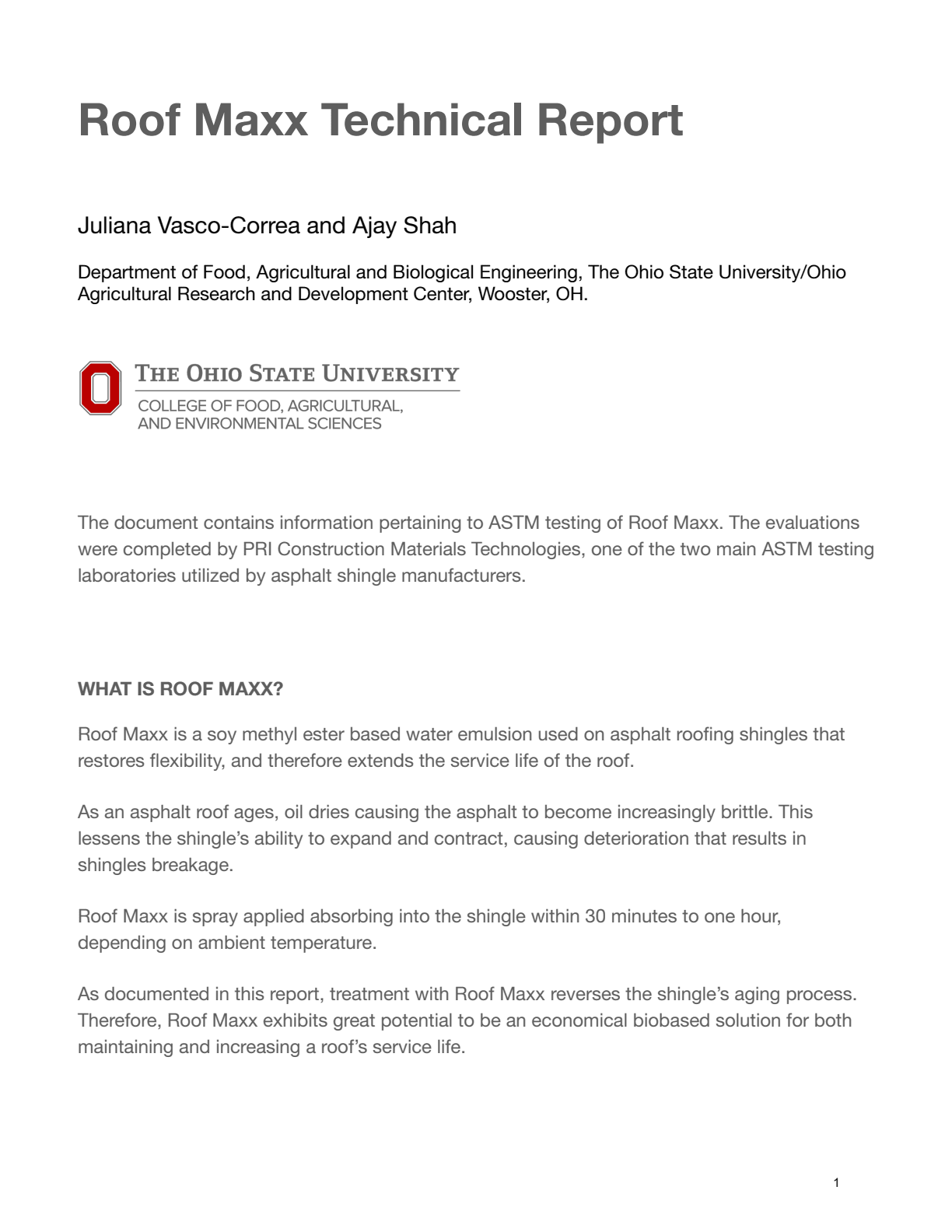
Vasco-Correa, J., & Shah, A. (2018). Roof Maxx Technical Report Final. Department of Food, Agricultural and Biological Engineering, The Ohio State University / OARDC Wooster. PRI Construction Materials Technologies tests on 17-year three-tab shingles at 1 gallon per 100 square feet.
The OSU study is not an endorsement of Roof Maxx by The Ohio State University.
What it does not do
- It does not repair structure or replace rotten decking.
- It does not seal active leaks.
- It is not for tile.
Who qualifies
Best on asphalt shingles that are tired but not failed: mat intact, granules mostly still on it, nothing leaking. Heavy granule loss, exposed mat, or a roof the insurer will not keep usually move the job to Roof Coat or replacement.
What you get back
We inspect and treat from the roof, and we photograph what we find on the way. You see the same pictures we work from, including the ones that say your roof does not need us yet.
What we fix first
Oil does not seal a hole. The tune-up runs the same day, ahead of the treatment, and it is how the roof gets sound enough to be worth treating. None of what follows is a change order at the end of the afternoon.
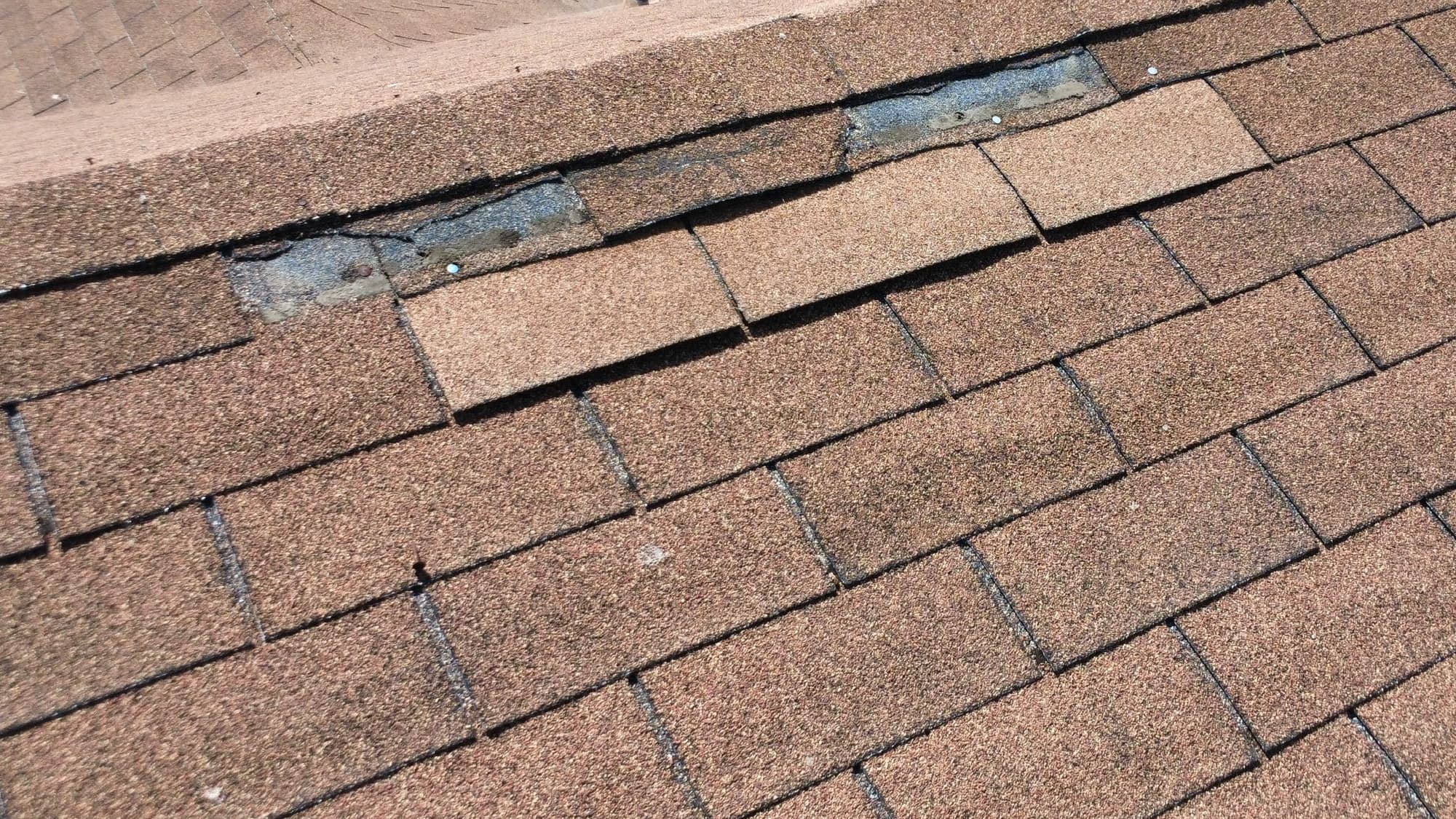
Missing tabs are the obvious one. Wind gets under an edge and takes the tab with it, and what it leaves open is the headlap of the course underneath — the thin unweathered strip that is holding the nails for the course above. We replace the tab. A new one will not match a field that has been in the sun for twenty years, and it weathers in.
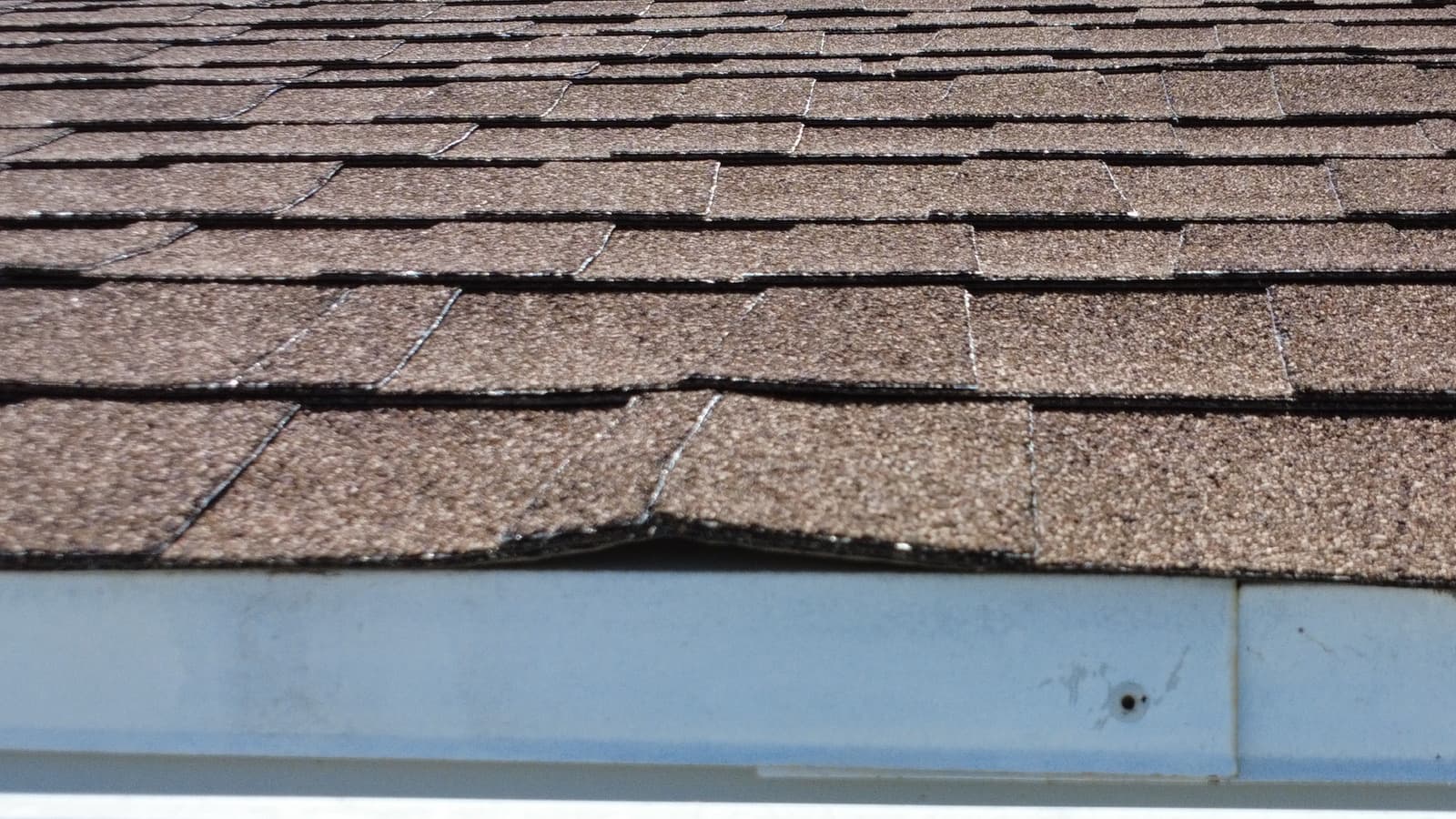
The other frame is the one people walk past. That bottom course is tented into a low ridge and lifted off the drip edge because a nail has worked its way back out and is pushing up underneath. It has not come through yet. Dry shingle is brittle, so left alone it will, and then it is a hole in the field instead of a nail to reseat.
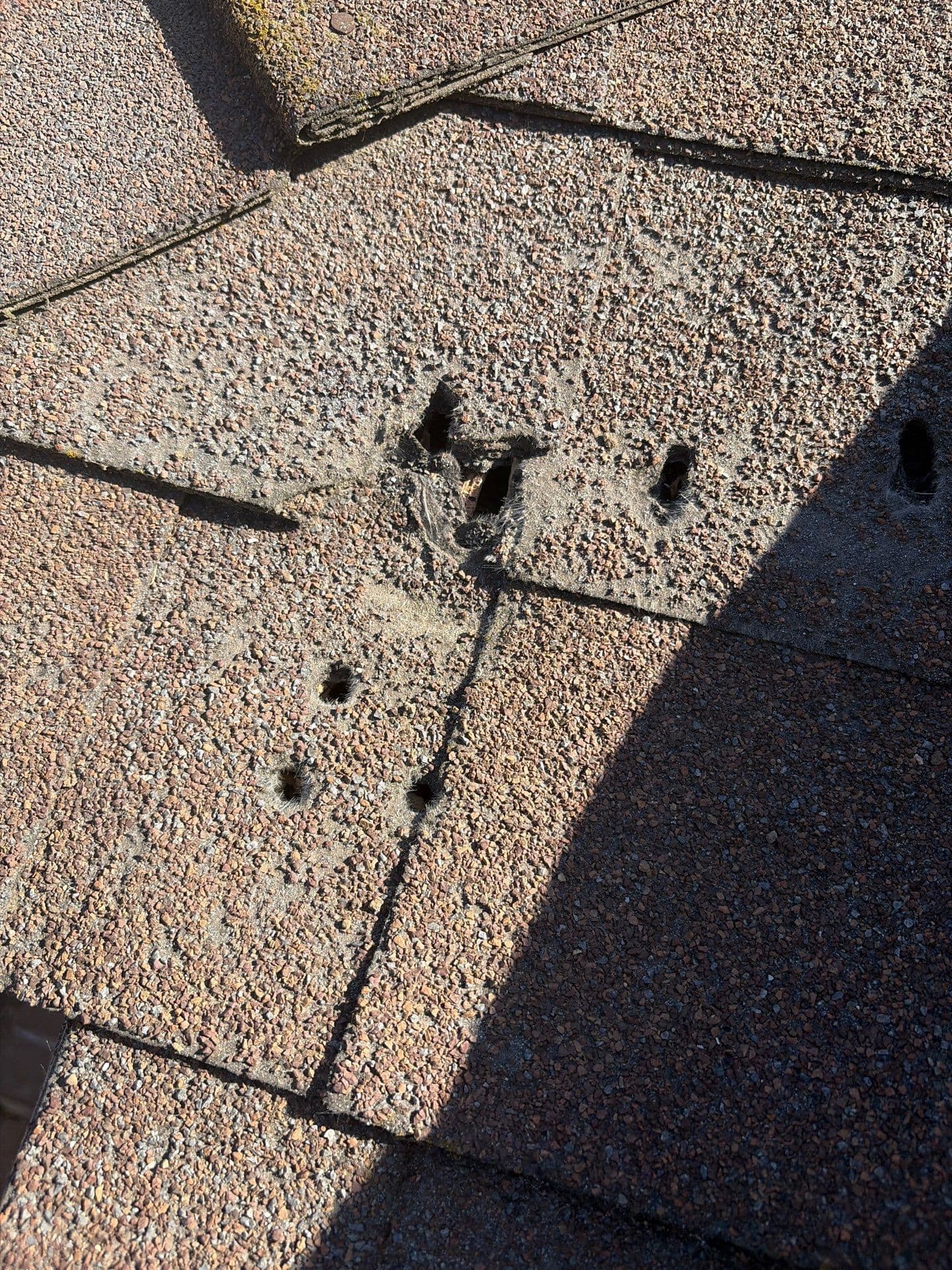
Open fastener holes are the ones nobody notices, because whatever was screwed down up there usually came off years ago and took the reason to look with it. They go straight through the shingle and into the deck.
Those get sealed, along with tired flashings and any pipe boot that has gone hard. Then the roof is ready for product.
A bad ridge is not a bad roof
The ridge is the most exposed line on the house. It takes sun from both sides all day and it is the first edge the wind gets under, so caps regularly give out years ahead of the shingle they sit on. On its own that is a repair, not a reason to replace a roof.
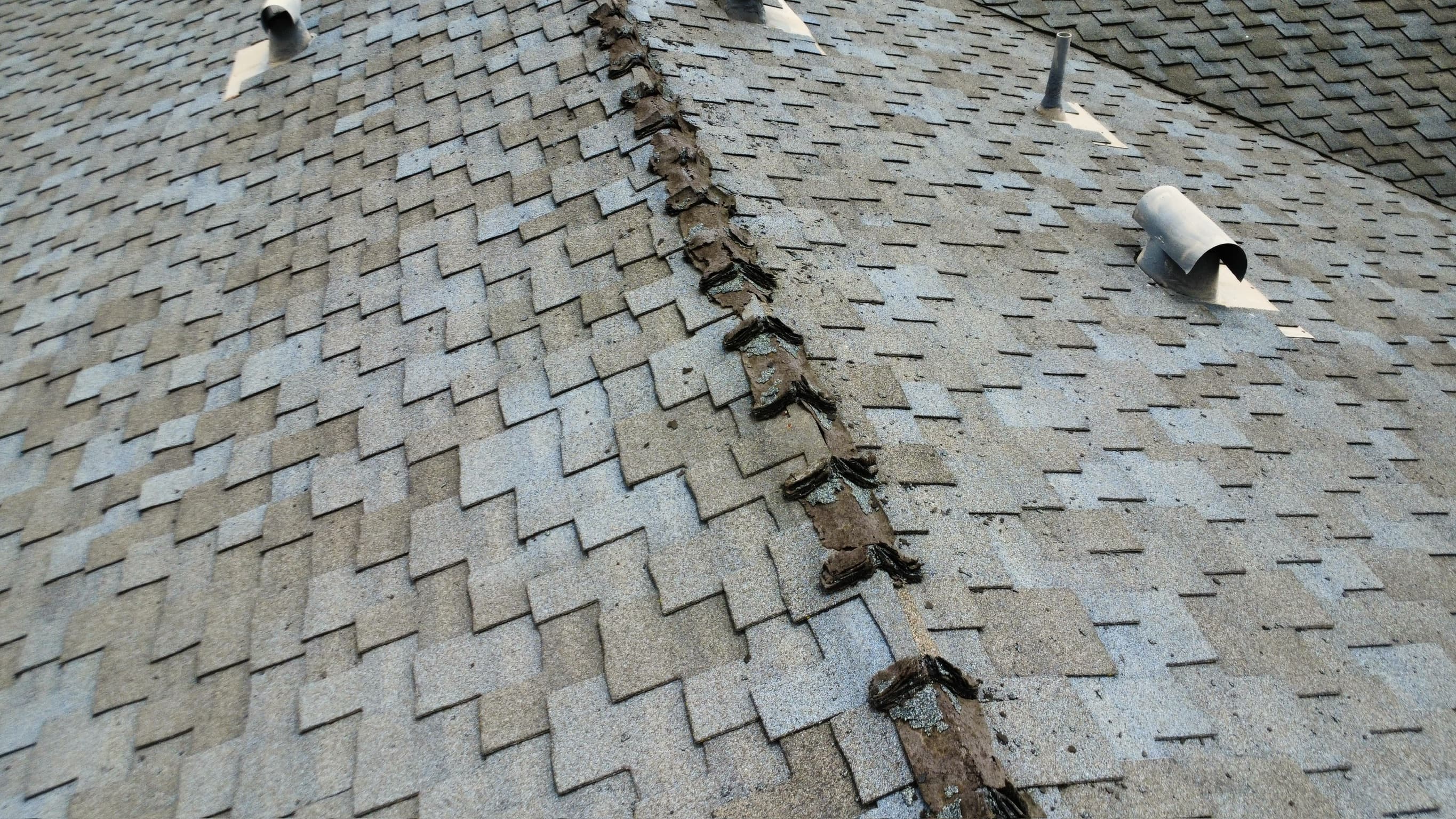
Both halves of the decision are in that one frame. The field is what we want to treat: granules still on it, tab edges clean, no mat showing on either slope. The caps are past repair. They have split into layers, the granules are gone, the mat underneath is open to the sky, and broken pieces of them are sitting on the shingle below.
So the caps come off. We strip them and the leftover material off the ridge, install new caps, and then run the standard full-service tune-up and treatment across the whole roof. It goes on the estimate as its own line rather than inside the tune-up, because it is material and labor, and you should see it priced instead of buried.
Read the field, not the ridge. The Ojai roof on the Roof Coat page is this one inverted: its caps had been dabbed with sealant for years, but the mat was showing through across every tab in the field, and that is what moved it off a treatment and onto a film.
The part of your roof that is not shingle
A lot of houses around here are pitched shingle everywhere except one piece — a porch, an addition, a second-story deck sitting nearly flat. That piece is usually rolled asphalt rather than shingle, and rejuvenating oil is not the answer for it. Oil soaks into a shingle. A rolled roof fails at its laps, and nothing you soak into it changes that.
It is not a reason to leave the rest of the roof alone. One house in Thousand Oaks split exactly that way: the steep hip took the full tune-up and the treatment, and the low-slope deck behind it took a white reflective coating instead, both on the same visit. That job is on the coatings page. If your house has both, say so when you call and we will look at both.
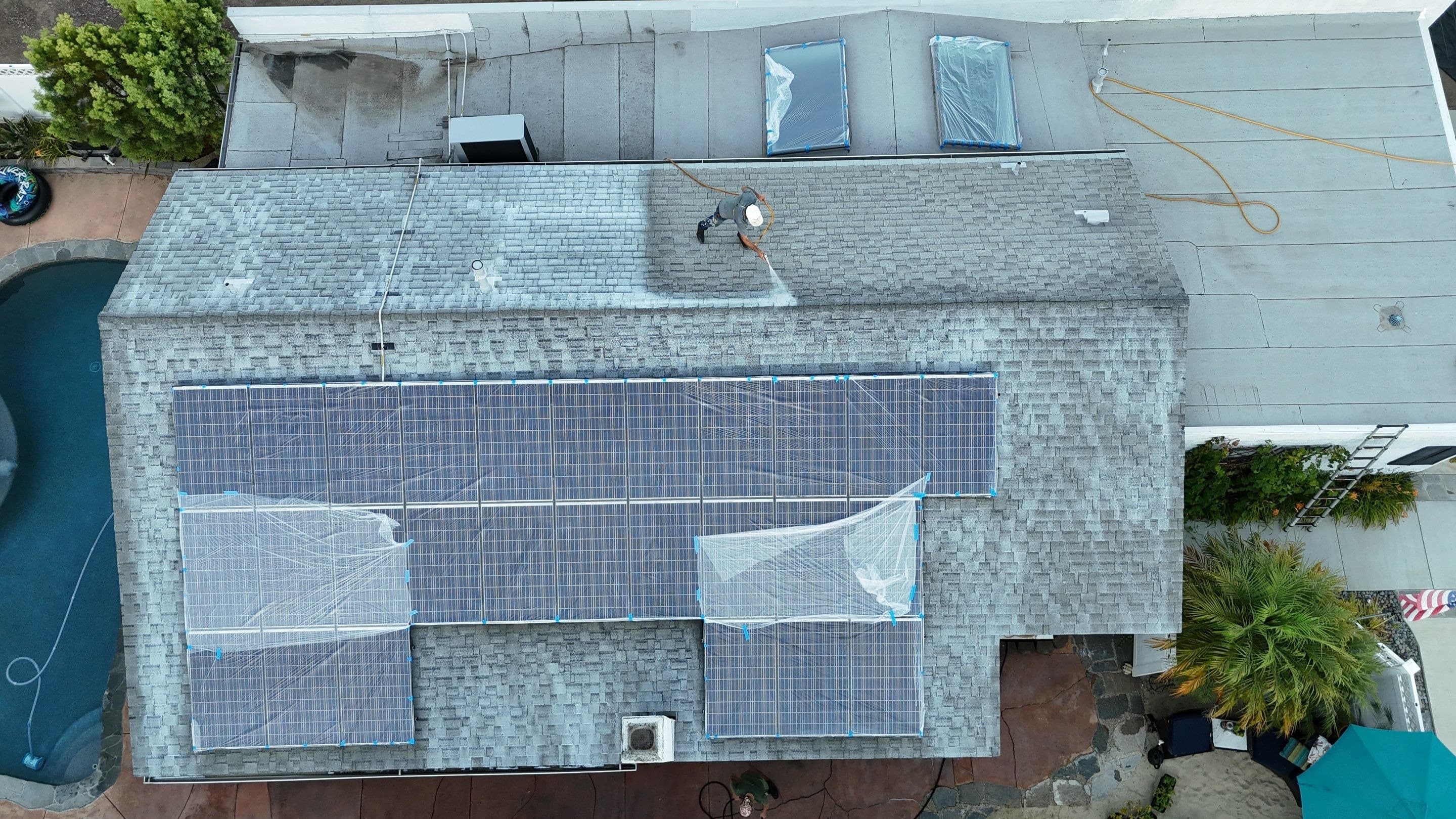
Solar stays where it is
Panels are the reason a lot of people put the job off. On a replacement the array has to come down and go back up, and that is a separate bill from the solar company stacked on top of the roofing bill.
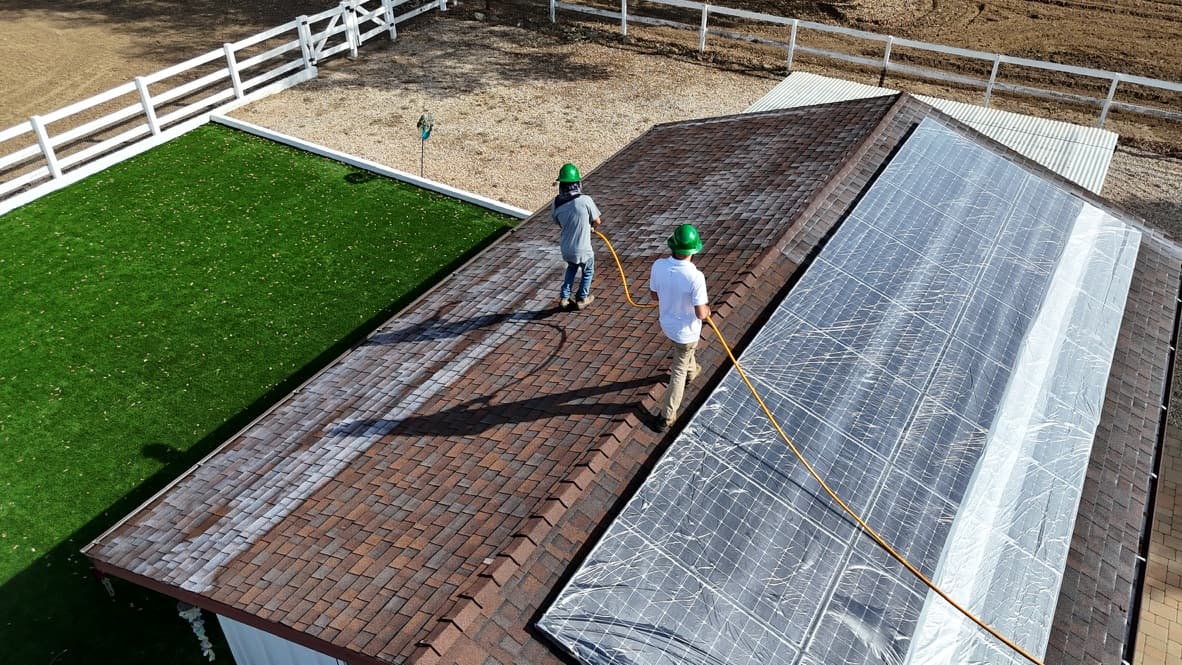
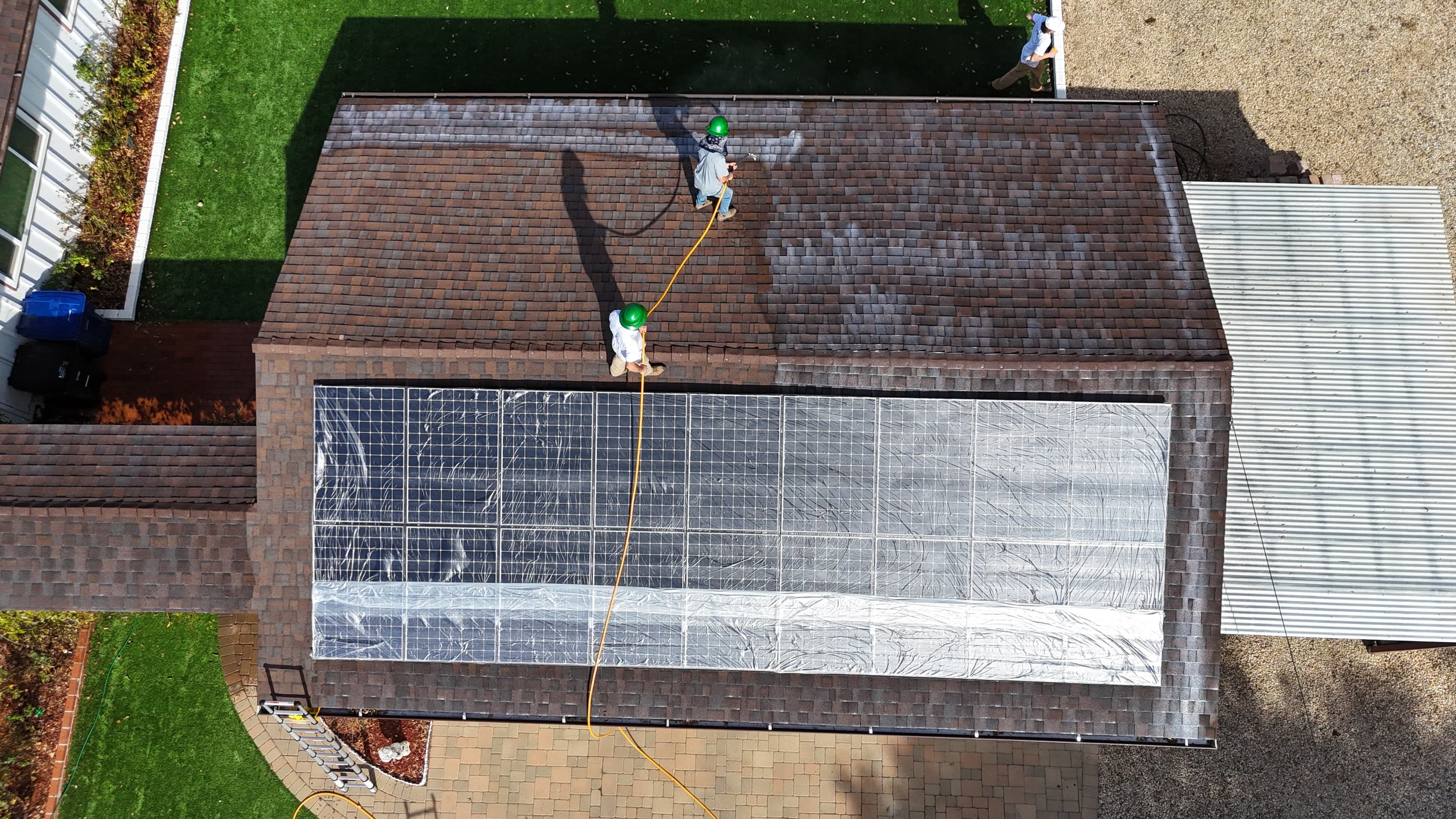
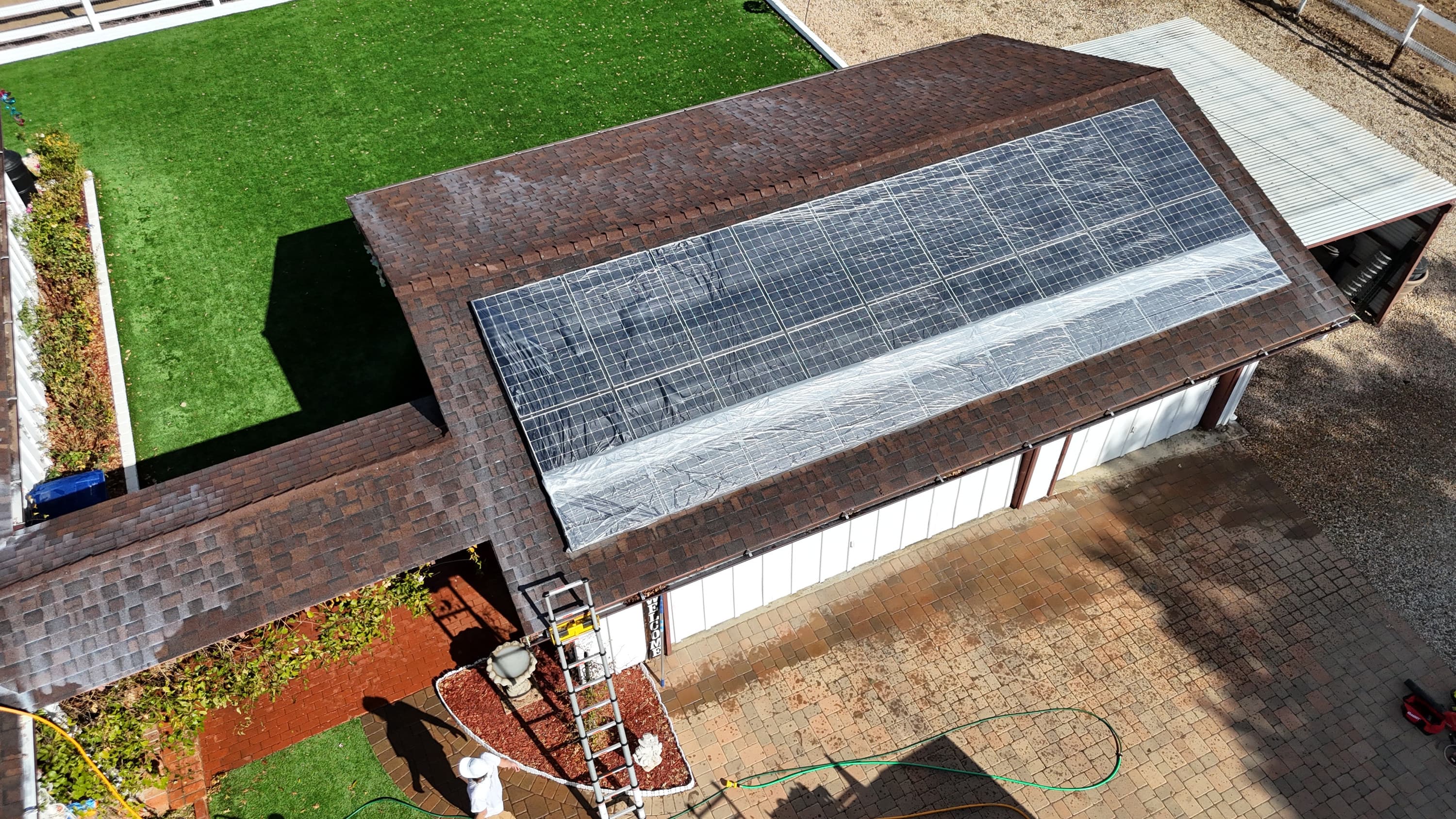
A treatment does not work that way. We sheet the array over before anything is sprayed, treat the shingle around and above it, and pull the covers at the end of the day. Nothing is unbolted and no panel leaves the roof.
The shingle underneath the panels is the one part we cannot reach. It is also the part that never sees direct sun, which is what dries the oil out of a shingle in the first place.
Covering comes first. The Simi Valley roof below is straight overhead before the first pass: every array wrapped, and the shingle around them still dry.
Fire performance
Independent testing found Roof Maxx did not reduce shingles' fire performance.
We do not claim Roof Maxx confers, upgrades, provides, or guarantees a Class A rating. It is not a non-combustible roofing solution. PRI spread-of-flame was a PRI proprietary method simulating ASTM E108 Class A. It was not the ASTM E108 test itself.
5.0 · 21 reviews
Google reviews · Roof Maxx of Simi Valley
“As senior citizens, the concern for our 23 year old roof was a concern. Our son informed us of a technology that is sprayed on to enhance the life of the roof. We contacted Roof Maxx and received a prompt response. Keith came to give us a free estimate. He took pictures with the drone as well as climbing up on the roof and pointing out what would need to be done. Keith's knowledge and belief in the process gave us the confidence to go forward. Not only does he come out for the estimate but he also does the work. Before the appointment he e-mailed the photos he took and exactly what it would cost. He also included a number of reference. The first person we went to visit for a reference could not say enough good about the crew and the work done. That's all we needed to know. The next week Keith was here along with the owner, Matt. The work was done in a matter of a few hours. We now have a clean looking protected roof along with a 5 year warranty. We highly recommend this company.”
“I don't normally write reviews but my experience with Roof Max was exceptional. The shingles on the back side of my home were losing a lot of their gravel and were beginning to curl at their edges. The front of the roof is still in pretty good shape. I was considering replacing the roof until I reached out to the company that installed my solar panels. They quoted a price of $30,000 which would include a $500 per panel fee for removing and reattaching the solar panels. I kept seeing the ads for RoofMax on television but kept putting off calling them. When I told my chiropractor about my roof issues, he suggested I call Spencer. I called Spencer and he came to my house that afternoon with a drone. He took numerous pictures of my roof and then we discussed what options I had. The front was in good shape and was a candidate for the regular oil-based Roof Max treatment, but the back roof wasn't because it had lost 60% of the protective gravel. Roof Coat was the option for the back roof, which is an acrylic paint that adds a protective layer for waterproofing and improves the look of the roof. The crew that did the work were very friendly, informative and efficient. Keith, Chase and Alex did an excellent job and my roof looks great. My problems with the roof were resolved within a few days of contacting Roof Max. I would highly recommend Roof Max out of Simi Valley.”
“We wanted to thank RoofMaxx for the amazing work they did on our home and garage. Keith and his assistant arrived right at the appointment time and completed the work with meticulous attention to detail including re-caulking needed areas, painting the stacks to match the roof, and even washing off the driveway and sidewalk. Our roofs look new again, and it's nice to know that this small financial investment is adding so many years to the integrity of our shingles and protecting us from potential water damage.”
“Roof Maxx explained the process and what it will do to extend the life of my roof. They showed up on time and completed the job. Total professionals from start to finish. Picture of Keith on my roof.”
“Keith was professional and thorough in his work with my properties. I appreciated how quickly he responded to my questions and requests. I am looking forward to seeing how the product weathers over time.”
“These guys were great! Not only did they apply a thorough coating of Roofmax product evenly over my roof, but they went around my home with a hose ensuring none of the product got on my walls or plants. They also do a great job of patching and caulking of all roof protrusions. Nice polite guys. Insurance company was satisfied. Would highly recommend!”
Questions we actually get
- What is Roof Maxx?
- Roof Maxx is a soy methyl ester based water emulsion. It is spray applied and absorbs into the shingle in 30 minutes to one hour, depending on ambient temperature. Asphalt shingles only. Not tile.
- How long does one treatment last?
- Each Roof Maxx treatment adds 5 years of warranted service life. Up to 3 treatments for a total of 15 years.
- Does it change fire performance?
- Independent testing found Roof Maxx did not reduce shingles' fire performance. We do not claim Roof Maxx confers, upgrades, provides, or guarantees a Class A rating. It is not a non-combustible roofing solution.
- What about hail?
- A more flexible shingle can absorb hail impact instead of cracking. That follows from the ASTM D3462 pliability result. We do not claim a hail-resistance rating, a Class 4 impact label, or an insurance discount.
- Did Ohio State endorse the product?
- The OSU study is not an endorsement of Roof Maxx by The Ohio State University.